A Technical Deep Dive into Secure, Scalable Digital Content Analysis
Introduction
As organizations evolve into digital-first enterprises, they generate and manage terabytes of unstructured data — PDFs, images, forms, and documents across multiple platforms. Whether it’s a state government consolidating department sites, a financial firm auditing disclosures, or a healthcare provider managing compliance documents, the challenge remains consistent:
How do we automatically govern digital assets to ensure privacy, accuracy, and compliance — at scale?
Manual content validation is neither sustainable nor secure. To address this, we developed an AI-powered content analysis utility, tightly integrated with Adobe Experience Manager (AEM) and Microsoft Azure Cognitive Services, which enables the automated detection of PII (Personally Identifiable Information) and sensitive content within documents and media files.
This post provides the technical deep dive version of my earlier Medium article, Transforming Digital Services with AI-Powered Content Analysis
Architecture Overview
At its core, the solution is a modular AI content governance framework hosted on Azure, with connectors for AEM and other CMS or storage systems.
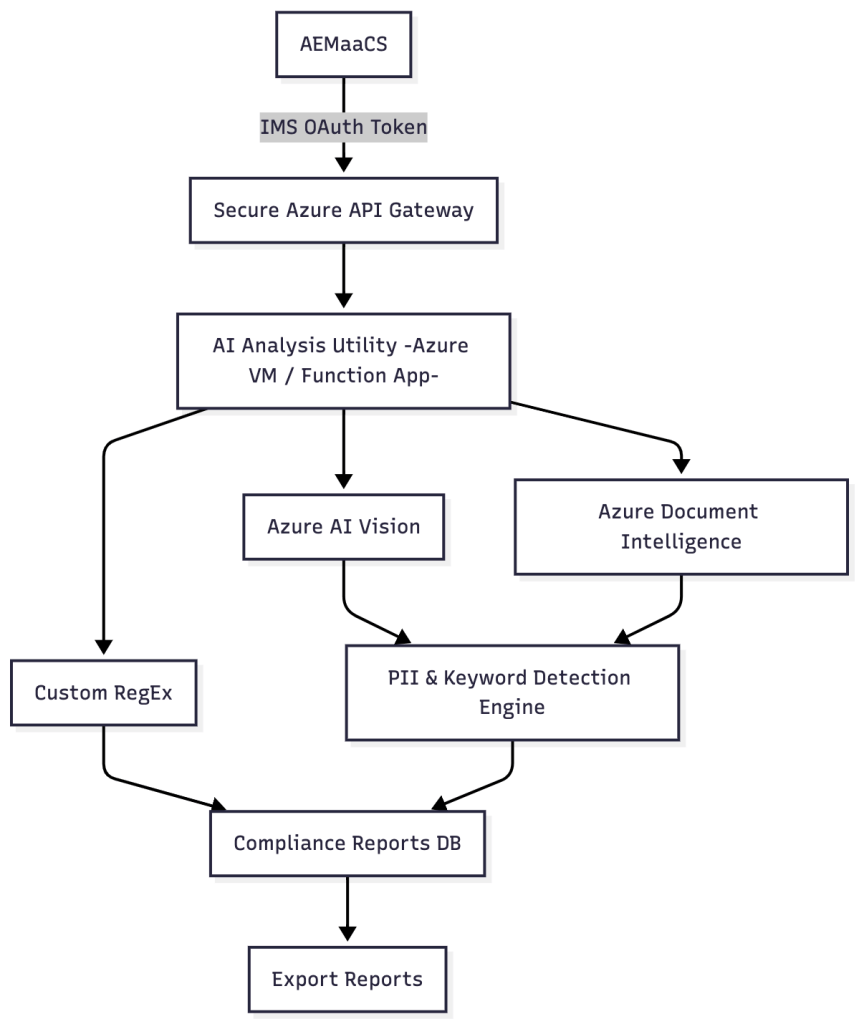
Key Components:
- AEM Author Connector: Fetches digital assets (PDFs, images) for analysis via secure API endpoints using technical service credentials.
- Azure API Gateway: Acts as a secure middle layer for authentication, rate-limiting, and data encryption in transit.
- AI Analysis Utility: Custom-built Azure Function App (or Containerized Python Service) that orchestrates data extraction, PII detection, and keyword classification.
- Custom RegEx: Custom patterns to identify PII or keywords
- Azure Cognitive Services:
- Document Intelligence: Extracts text and structure from PDFs, scanned forms, and documents.
- AI Vision: Performs OCR and text-in-image detection for JPEGs, PNGs, and other visual assets.
- Report Database: Stores flagged assets, detection metadata, and confidence scores for downstream reporting.
- Export Reports: Users can export reports or view data on the dashboard.
Data Flow and Processing Lifecycle
Asset Ingestion
Assets are identified in AEM via a scheduled scan or manual trigger. The connector retrieves asset metadata through secure API endpoints using the AEM Technical Account (IMS service credential).
// Authenticate with AEM using Adobe IMS Technical Account
var token = await GetAemAccessTokenAsync();

// Fetch asset metadata securely
using var client = new HttpClient();
client.DefaultRequestHeaders.Authorization =
    new AuthenticationHeaderValue("Bearer", token);
Secure Transmission
- Assets are transferred to Azure via HTTPS with token-based authentication.
- Sensitive data is encrypted in transit using TLS 1.3.
Content Extraction
Azure’s AI services extract structured and unstructured data from assets.
using Azure;
using Azure.AI.FormRecognizer.DocumentAnalysis;

var client = new DocumentAnalysisClient(
    new Uri(endpoint), new AzureKeyCredential(apiKey));

var operation = await client.AnalyzeDocumentFromUriAsync(
    WaitUntil.Completed, "prebuilt-read", new Uri(fileUri));

foreach (var page in operation.Value.Pages)
    foreach (var line in page.Lines)
Console.WriteLine(line.Content);- Azure Document Intelligence parses PDFs and forms, extracting textual and structural metadata (e.g., tables, signatures, form fields).
- Azure AI Vision extracts text embedded in images or scanned forms.
PII & Keyword Detection
The extracted text passes through a custom pipeline using regular expressions and optionally Azure AI Language for classification.
var patterns = new Dictionary<string, string>
{
    { "SSN", @"\b\d{3}-\d{2}-\d{4}\b" },
    { "Email", @"[A-Za-z0-9._%+-]+@[A-Za-z0-9.-]+\.[A-Za-z]{2,}" },
    { "Phone", @"\(?\d{3}\)?[-.\s]?\d{3}[-.\s]?\d{4}" },
    { "CreditCard", @"\b\d{4}[- ]?\d{4}[- ]?\d{4}[- ]?\d{4}\b" }
};

foreach (var kvp in patterns)
    foreach (Match match in Regex.Matches(content, kvp.Value))
        Console.WriteLine($"{kvp.Key}: {match.Value}");
This layer identifies:
- Phone numbers, SSNs, Tax IDs, Credit Cards, Email IDs
- Age, Date of Birth, License Numbers, Bank Account Numbers
- Custom entity types, such as “internal,” “confidential,” or domain-specific terms.
Result Storage & Reporting
Each processed asset generates a record in the Azure SQL Database with asset path, PII type, confidence score, and timestamp
using var con = new SqlConnection(sqlConn);
await con.OpenAsync();

var cmd = new SqlCommand(
  "INSERT INTO PiiResults (AssetPath, EntityType, Confidence, Timestamp) VALUES (@a,@e,@c,@t)", con);
cmd.Parameters.AddWithValue("@a", assetPath);
cmd.Parameters.AddWithValue("@e", entityType);
cmd.Parameters.AddWithValue("@c", confidence);
cmd.Parameters.AddWithValue("@t", DateTime.UtcNow);
await cmd.ExecuteNonQueryAsync();
Reports are then exposed through the custom app view for follow-up actions
Remediation & Governance Loop
- Content authors receive alerts for flagged assets.
- Workflow rules can auto-quarantine files or restrict publication until review.
Security and Compliance
The architecture was designed to meet enterprise-grade data security and government compliance standards:
| Layer | Security Control | Description |
|---|---|---|
| Network | Azure Private VNet | All data processing occurs inside an internal subnet, isolated from public endpoints. |
| Authentication | Managed Identity (MSI) | Eliminates the need for credentials; uses Azure AD for tokenized access. |
| Storage | Azure Blob with SSE | All temporary files encrypted with server-side encryption and deleted post-analysis. |
| Data Residency | Regional Isolation | Processing remains within the customer’s Azure region. |
| Audit Logs | Azure Monitor + Log Analytics | Tracks every transaction, access request, and file operation. |
This ensures end-to-end confidentiality — no content leaves the organization’s boundary, even during AI processing.
Integration Patterns
The framework supports multiple content ecosystems beyond AEM:
| Platform | Integration Mode | Example Use |
|---|---|---|
| AEMaaCS / AEM On-Prem | API + Asset workflow | Pre-publish validation, DAM compliance scanning |
| Azure Blob / AWS S3 | Direct scan via SDK | Enterprise content archiving and audit |
| FTP / On-Prem Repositories | .Net connector | Legacy document ingestion |
Reporting and Insights
Reports generated by the system include:
- PII Summary Dashboard — Total flagged assets, grouped by severity and type.
- Keyword Heatmaps — High-frequency sensitive terms across repositories.
- Asset Compliance Score — Weighted metric (0–100) showing each asset’s compliance health
Example fields in report output:
| Asset Path | Entity Type | Confidence | Timestamp |
|---|---|---|---|
/content/site/docs/permit.pdf | SSN | 0.97 | 2025-10-15 09:12 |
/content/site/images/form.png | 0.89 | 2025-10-15 09:15 |
Deployment Note
Currently, the .NET Core analysis utility runs inside an Azure VM, providing full control for tuning and testing.
It can seamlessly migrate to an Azure App Service or Function App for elasticity and cost optimization.
# Current hosting (Azure VM)
dotnet publish -c Release -o /var/www/pii-scanner
systemctl start pii-scanner.service

# Future migration (App Service)
az webapp up --runtime "DOTNET|8.0" --name aem-ai-governance
Future Enhancements
The framework is modular and extensible for next-gen AI integrations:
- Multi-cloud orchestration across Azure, AWS, and GCP.
- Automated translation and sentiment tagging for multilingual content.
- GenAI summarization of long-form documents for accessibility compliance (WCAG 2.1).
- Adaptive Learning Models that improve accuracy from feedback loops.
Conclusion
By integrating AEM, Azure Cognitive Services, and AI-driven detection models, this framework redefines digital content governance. It transforms manual reviews into automated, auditable, and intelligent compliance workflows — ensuring every document is accurate, private, and trustworthy.
AI-powered governance isn’t just about automation — it’s about building digital trust through intelligence, transparency, and accountability.


 The Modern Enterprise Insights by Sachin Magon
Leave a reply to Hemant Singh Cancel reply